Dawn awakens on a
perfectly beautiful day the Lord made, birds chirping, livestock is grazing. People are waking up to another day of hard work, the children having hungry stomachs, in Jerusalem. The Sabbath day of rest is tomorrow after this day, Friday April 3rd, 33 AD. This is a very special day in all history. The set-apart day the
earth would quake, the sun be blotted out, and the day Mary and Joseph’s son, the God-man Jesus
Christ, would pay it all, just for us!
Please note that some of the content contained within the Reflection Moments depicted here is not recorded in the scriptures. They are merely human attempts to relate and ask some questions of certain aspects of the Son of God, which may help you see the Savior’s human side of His divine life on earth.
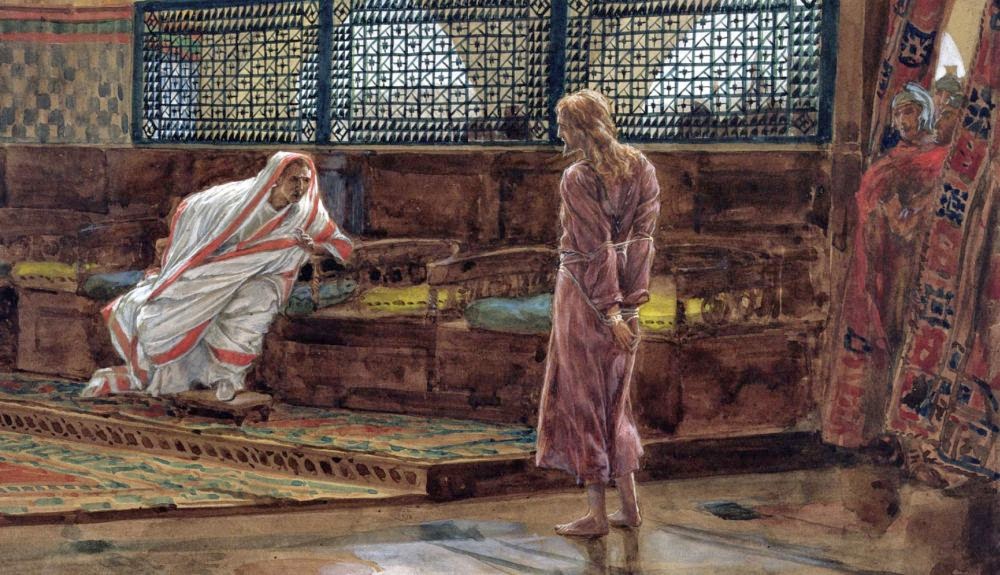
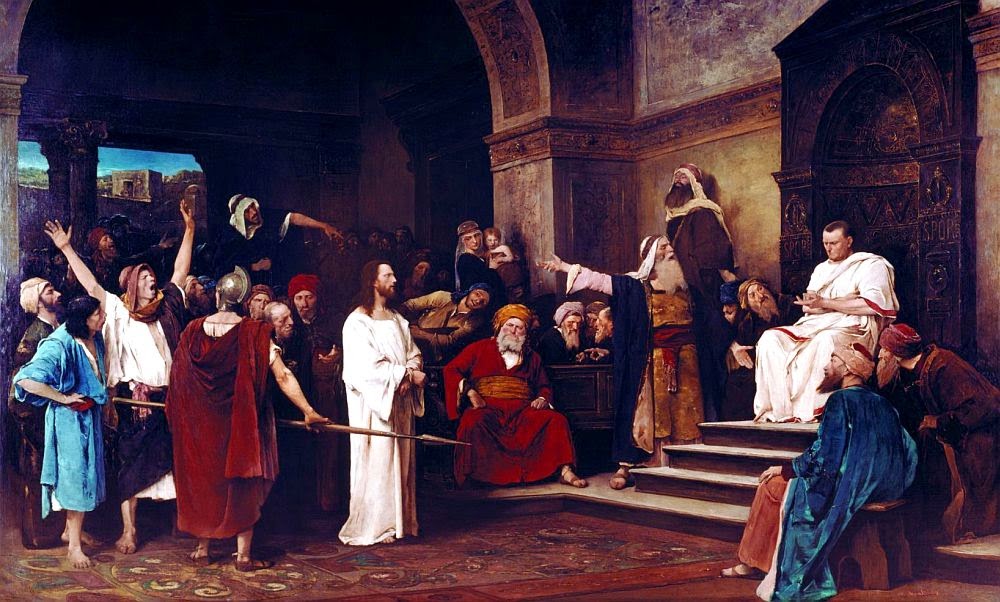

Pontius Pilate was the Roman procurator in Judea from 26 to 36 A.D. (Luke 3:1) He will forever go down in history as the man who being persuaded by the Jewish authorities against his will, ordered the crucifixion of Jesus!
 In the New Testament Pontius
Pilate first appears around 6 am Friday morning during the time of the Passover Feast in Jerusalem and is
confronted with the person of Jesus, who is accused of treason and blasphemy by
the Jewish authorities. Pilate must act as Jesus' judge.
In the New Testament Pontius
Pilate first appears around 6 am Friday morning during the time of the Passover Feast in Jerusalem and is
confronted with the person of Jesus, who is accused of treason and blasphemy by
the Jewish authorities. Pilate must act as Jesus' judge.
Jerusalem, early Friday morning, April 3rd
 So Pilate came out to them
and asked, "What charges are you bringing against this man?" "If
he were not a criminal," they replied, "we would not have handed him
over to you." Pilate said, "Take him yourselves and judge him by your
own law." "But we have no right to execute anyone," the Jews
objected. This happened so that the words Jesus had spoken indicating the kind
of death he was going to die would be fulfilled. Pilate then went back inside
the palace, summoned Jesus and asked him, "Are you the king of the
Jews?" (John 18:33)
So Pilate came out to them
and asked, "What charges are you bringing against this man?" "If
he were not a criminal," they replied, "we would not have handed him
over to you." Pilate said, "Take him yourselves and judge him by your
own law." "But we have no right to execute anyone," the Jews
objected. This happened so that the words Jesus had spoken indicating the kind
of death he was going to die would be fulfilled. Pilate then went back inside
the palace, summoned Jesus and asked him, "Are you the king of the
Jews?" (John 18:33)
That was not a question that could be answered with a simple “yes” or “no.” No, he was not a political king who had come to establish earthly Jewish supremacy (a lesson some religionists could well learn today), but yes, he was the long awaited king of the Jewish scriptures.
"Is that your own idea," Jesus asked, "or did others talk to you about me?" "Am I a Jew?" Pilate replied. "It was your people and your chief priests who handed you over to me. What is it you have done?"
Jesus said, "My kingdom is not of this world. If it were, my
servants would fight to prevent my arrest by the Jews. But now my kingdom is
from another place." "You are a king, then!" said Pilate. Jesus answered, "You are right in saying I am a king. In fact, for this
reason I was born, and for this I came into the world, to testify to the truth.
Everyone on the side of truth listens to me."
"What is truth?" Pilate asked. With this he went out again to the Jews and said, "I find no basis for a charge against him." (John 18:29-38)
 Pilate continued to question Jesus since he knew he was innocent, but he had a roaring crowd that demanded Jesus be killed! Pilate told the Jews that he could find no fault in Jesus at all (John 18:38) but the Jews by now were so incensed Pilate even tried to release Jesus according to the Jewish custom at Passover for the offering of Barabbas in His place, a robber. The Jews wouldn't have it and shouted, "Not this man (Jesus), but Barabbas, release him." (John 18:40)

Around 7:30 am, the soldiers began flogging the God-man, relentlessly using an instrument that had flesh tearing implements built into it. There is no words to describe this scene. Jesus remained silent!


 Jesus was then mocked by the Roman soldiers and clothed with a purple robe and a crown of thorns smashed upon His head saying,
"Hail, King of the Jews."
Then Jesus came out wearing the crown of thorns and the purple robe. And Pilate said to them, "Behold the Man!"
Therefore, when the chief priests and officers saw Him, they cried out,
"Crucify Him, crucify Him!"
Pilate said to them, "You take Him and crucify Him, for I find no fault in Him."
Reflection Moment
We can see Pilate trying to convince the Jews of Jesus innocence a few times up to now, and he's not finished yet. What was his purpose to continue the case for innocence? The scripture says he was "The more afraid" (John 19:8)
All that he had heard related of the miracles of Jesus, the mysterious character of His person, of His words and of His conduct, the strange message which he had just received from his wife - all is suddenly explained by the term "Son of God." Was this extraordinary man truly a divine being who had appeared on the earth? The truth naturally presents itself to his mind in the form of pagan superstitions and mythological legends"
Pilate's conscience fights for Christ, but it immediately yields, because it is not upheld with the power of God.
Pontius Pilate tried one more time saying, "Do You not know that I have the power to crucify You, and power to release You?" Jesus answered,
 Pilate finally said to the Jews, "Behold your King." But they cried out, "Away with Him, away with Him! Crucify Him! Pilate said to them, "Shall I crucify your King?" The Jews answered, "We have no King but Caesar!" Then he delivered Him to them to be crucified. So they took Jesus and led Him away. (John 19:14-16)

 Reflection Moment


Jesus Buried in Joseph’s Tomb
(6) "It is Finished”
click to play
Please note that some of the content contained within the Reflection Moments depicted here is not recorded in the scriptures. They are merely human attempts to relate and ask some questions of certain aspects of the Son of God, which may help you see the Savior’s human side of His divine life on earth.
Pilate's first interview with Jesus at 6 am. "Who are You?"
Pilate said to the priests and elders at 8 am, "What shall I do with Jesus who is called Christ?"
Within this series of Gods
Great Love for Us, we have often referred to Jesus in the wood shop during His formative years at home in Nazareth.
Descriptions such as Mary and Joseph’s son, the Carpenter, God in the flesh and
the God-man are descriptions showing us Gods human nature while simultaneously
possessing the divine nature as God. It is significant Jesus the Christ, God
Himself be described in these human terms for a couple very important reasons.
One, so you and I can relate to God on our level (Phil. 2:5-7). And two, so that
we can know what, who and how God is in order to learn how to grow in Jesus to
become more and more like Him (Rom. 15:5-6). God who is perfect in every way understands
our shortcomings in order to love and discipline us not out of anger, but from
love because He is love (1 Jn. 4:8). He is where love comes from in the human
race. For it is in the bible that we learn to know about
Christ and His ultimate focal point - The cross He is about to endure - for us.
Period replica bust of Pontius Pilate
“When morning came, all the chief priests and elders of the people plotted against Jesus to put Him to death. And when they had bound Him, they led Him away and delivered Him to Pontius Pilate the governor.” (Matthew 27:1-2)
Pontius Pilate was the Roman procurator in Judea from 26 to 36 A.D. (Luke 3:1) He will forever go down in history as the man who being persuaded by the Jewish authorities against his will, ordered the crucifixion of Jesus!
Jerusalem, early Friday morning, April 3rd
That was not a question that could be answered with a simple “yes” or “no.” No, he was not a political king who had come to establish earthly Jewish supremacy (a lesson some religionists could well learn today), but yes, he was the long awaited king of the Jewish scriptures.
"Is that your own idea," Jesus asked, "or did others talk to you about me?" "Am I a Jew?" Pilate replied. "It was your people and your chief priests who handed you over to me. What is it you have done?"
"What is truth?" Pilate asked. With this he went out again to the Jews and said, "I find no basis for a charge against him." (John 18:29-38)
Reflection Moment
The question to Jesus, “Are you the King of the Jews” from
Pilate is curious. According to the gospel account by John, Jesus was asking
for clarification from Pilate through a rhetorical question. That is, Jesus was
clarifying with Pilate as to whether or not the indictment was second-hand
(i.e., is it that others say that I am a King of the Jews?) versus Pilate
himself. In other words, was the indictment because Rome saw Jesus as a king,
or because others said that Jesus was a king? To put it another way, if there
was no threat to Rome (since it was not Pilate accusing Jesus of being a king),
then why is Jesus being charged at the instigation of third-parties?
When Pilate clarified that it
was the former case (others accusing you of being a king), Jesus then indicated
that this "kingdom" for which he was king had no fighters, and therefore
was non-violent. (There was no threat to Rome) Jesus indicated that the essence
of this kingdom was truth. Pilate responded with "What is truth?" (John 18:38), and determined in the same
verse that there was therefore no legal basis for an indictment. Pilate said to
Him, “What is truth?” And when he had
said this, he went out again to the Jews and said to them, “I find no guilt in Him.” Later we read Apostle Paul confirming to
Timothy (1 Timothy 6:13), “I charge you
in the presence of God, who gives life to all things, and of Christ Jesus, who
testified the good confession before Pontius Pilate.”
Of all the innocent people that ever lived on
this planet, Jesus the God-man was the most innocent human there ever was.
Around 7:30 am, the soldiers began flogging the God-man, relentlessly using an instrument that had flesh tearing implements built into it. There is no words to describe this scene. Jesus remained silent!
The Flagrum was a whip with a
short handle and generally two or three long thick thongs, each weighted at
some distance from their extremity with lead balls or mutton bones. In action,
the thongs cut the skin, while the balls or bones created deep contusions. The
result was significant hemorrhage and considerable weakening of the vital
resistance of the victim. In compensation, if one may call it that, this
weakening shortened their agony on the cross.
Hebrew law was strict on limiting
the lashes to 40. The Pharisees, in order to make sure that they never broke
the law, gave only 39 lashes. The Romans had no limit, except for the fact that
the victims should be left with just enough strength to carry their crosses to
the place of execution. As the man who condemned Jesus to be flogged was
Pilate, the Roman Proconsul, the number of lashes could be unlimited. The
Gospels report that Jesus could not carry his cross without calling to an
onlooker for help. This suggests a very severe beating.
Why was Jesus Christ torn and beaten? The Apostle Peter tells us, "Who his own self bare our sins in
his own body on the tree, that we, being dead to sins, should live unto
righteousness: by whose stripes ye were healed. For ye were as sheep going
astray; but are now returned unto the Shepherd and Bishop of your souls." (1
Peter 2:24-25) Christ had no sins of His own (1 Peter 2:22). He was paying for
our sins. The scourge is a symbol of the awfulness of our sin and the terrible
price Christ personally paid for our sins (Isaiah 52:14).
.
"Hail, King of the Jews."
Then Jesus came out wearing the crown of thorns and the purple robe. And Pilate said to them, "Behold the Man!"
Therefore, when the chief priests and officers saw Him, they cried out,
"Crucify Him, crucify Him!"
Pilate said to them, "You take Him and crucify Him, for I find no fault in Him."
Reflection Moment
We can see Pilate trying to convince the Jews of Jesus innocence a few times up to now, and he's not finished yet. What was his purpose to continue the case for innocence? The scripture says he was "The more afraid" (John 19:8)
All that he had heard related of the miracles of Jesus, the mysterious character of His person, of His words and of His conduct, the strange message which he had just received from his wife - all is suddenly explained by the term "Son of God." Was this extraordinary man truly a divine being who had appeared on the earth? The truth naturally presents itself to his mind in the form of pagan superstitions and mythological legends"
Pilate's conscience fights for Christ, but it immediately yields, because it is not upheld with the power of God.
Pontius Pilate tried one more time saying, "Do You not know that I have the power to crucify You, and power to release You?" Jesus answered,
"You could have no power at all against Me unless it had been given you from above. Therefore the one who delivered Me to you has the greater sin."
(John 19:11)

When Pilate saw that he could not prevail at all, but rather that a tumult was rising, he took water and washed his hands before the multitude, saying, "I am innocent of the blood of this Person, you see to it."
(Matt 27:24)
(John 19:11)
When Pilate saw that he could not prevail at all, but rather that a tumult was rising, he took water and washed his hands before the multitude, saying, "I am innocent of the blood of this Person, you see to it."
(Matt 27:24)
Jesus looking to His Father see’s the cross and the fulfillment of all
prophesies about Him in front of Him. This is where he will finish the work His Father sent Him for. After just being severely beaten near
to death, He maintains incredible clarity and purpose in His human form. Though the
scriptures do not state such, as a man in bitter pain and agony with body
fluids secreting, He surely recalled His life as a young boy and His childhood.
As a man He surely remembered working and shaping wood that formed many pieces of furniture, helping
His step father in the business. And surely He remembers that one momentous early dawn when He took that first divine step out of the wood shop 3-1/2 years ago
towards Jerusalem where He is now calling all of mankind to repent, believe and be baptized in His name.
His next appointment is clear even through all of this. The pain and suffering
will increase, and the world will change in an instant. The Son of God is now
about to fully glorify His Father bringing forth Gods redemption plan to
mankind for all of eternity. Jesus the God-man will not waver, all because of
His Great Love for us!
There is no way to prove or surmise the origin of the wooden mallet that pounded the nails through Jesus body on His cross. I say "His cross" because no other person can or could bear this singular cross of burden and pain much more the perfect blood for our sin as He is about to commit. But just for a moment, what if that singular mallet somehow in Gods providence was one that Jesus Himself fabricated in the wood shop? The reality of this being the case can only make us wonder. But on the real side of this thought is, Jesus did in fact make the wood, the elements that produced the nails, and the soldier that held the nails and forced the blows! This soldier and his cohorts sin is being paid for right before their eyes! Will they see it?
The seven sayings of Jesus on the cross before He gave up His breath.
 Reflection Moment
 Now as they came out, they
found a man of Cyrene, Simon by name. Him they compelled to bear His cross. And
when they had come to a place called Golgotha, that is to say, Place of a
Skull, they gave Him sour wine mingled with gall to drink. But when He had
tasted it, He would not drink. Then they crucified Him, and divided His
garments, casting lots, that it might be fulfilled which was spoken by the
prophet:
Now as they came out, they
found a man of Cyrene, Simon by name. Him they compelled to bear His cross. And
when they had come to a place called Golgotha, that is to say, Place of a
Skull, they gave Him sour wine mingled with gall to drink. But when He had
tasted it, He would not drink. Then they crucified Him, and divided His
garments, casting lots, that it might be fulfilled which was spoken by the
prophet:
The seven sayings of Jesus on the cross before He gave up His breath.
- Luke 23:34: Father, forgive them, for they do not know what they do.
- Luke 23:43: Truly, I say to you, today you will be with me in paradise.
- John 19:26–27: Woman, behold your son. Son Behold your mother.
- Matt. 27:46, Mark 15:34: My God, My God, have you forsaken me?
- John 19:28: I thirst.
- John 19:29-30: It is finished.
- Then the sun was darkened, and the veil of the temple was torn in two. And when Jesus had cried out with a loud voice, He said, "Father, into your hands I commit my spirit."
Item 4 above is probably the most perplexing question from the Savior in all of mankind we may never fully grasp. Why as the Son of God did Jesus say – “My God, My God,
why have you forsaken Me.?”
It is hoped you can find the time to watch this most thrilling study into the mind of Christ that will enrich your understanding of Jesus of Nazareth on this question - "Why?"
It is hoped you can find the time to watch this most thrilling study into the mind of Christ that will enrich your understanding of Jesus of Nazareth on this question - "Why?"
“They divided My garments among them, And for My clothing they cast lots.” (Psalm 22:18)
Sitting down, they kept watch
over Him there. And they put up over His head the accusation written against
Him:
THIS IS JESUS THE
KING OF THE JEWS
"The Ninth Hour"
"Father, 'into Your hands I commit My spirit."
Having said this, He breathed His last. (Luke 23:46)
When Jesus died, the temple veil in
front of the Holy of Holy’s was torn, and the earth quaked and many saints resurrected (Matt 27:51-53). God moved out of that place never again
to dwell in a temple made with hands (Acts 17:24). God was through with that
temple and its religious system. The temple and Jerusalem were left “desolate”
(destroyed by the Romans) in A.D. 70, just as Jesus prophesied in Luke 13:35. Hebrews
9:8-9 refers to the age that was passing away as the new covenant was being
established (Hebrews 8:13). As long as the temple stood, it signified the
continuation of the Old Covenant which sadly today, the Orthodox Jews (Hasidim)
are continuing the tradition by undergoing the building of a new temple - but
God will not be there! At the moment of
Jesus death being the perfect sacrifice, Gods justice was satisfied making Him accessible
by all mankind without the need for priesthood representation before Him. Jesus
Christ the Son is now our advocate before the Father forevermore. Hallelujah…
Jesus Buried in Joseph’s Tomb
Now when evening had come,
there came a rich man from Arimathea, named Joseph, who himself had also become
a disciple of Jesus. This man went to Pilate and asked for the body of Jesus.
Then Pilate commanded the body to be given to him. When Joseph had taken the
body, he wrapped it in a clean linen cloth, and laid it in his new tomb which
he had hewn out of the rock; and he rolled a large stone against the door of the
tomb, and departed. And Mary Magdalene was there, and the other Mary, sitting
opposite the tomb. (Matt. 27:57-61)
Pilate Sets a Guard
On the next day, which
followed the Day of Preparation, the chief priests and Pharisees gathered
together to Pilate, saying, “Sir, we
remember, while He was still alive, how that deceiver said, ‘After three days I
will rise.’ Therefore command that the tomb be made secure until the third day,
lest His disciples come by night and steal Him away, and say to the people, ‘He
has risen from the dead.’ So the last deception will be worse than the first.”
Pilate said to them, “You have a guard;
go your way, make it as secure as you know how.” So they went and made the
tomb secure, sealing the stone and setting the guard. (Matt. 27:62-66)
Our exploration of the life,
ministry and extremely difficult road Jesus Christ traveled to the cross is
truly the greatest story ever told, and the greatest life ever lived. And He
lived it all because of His Great Love for Us. Have you ever wondered or even
had the nerve to go a little deeper into the truth of Jesus the God-mans sufferings?
This short video from a Medical Doctor reveals to us the physical and mental
anguish that Jesus went through during the final hours that last day beginning
at the garden of Gethsemane. Any bible student owes it to
themselves to listen closely to what the Lord Jesus, that young boy from Galilee
actually went through to try and understand what He endured for us. If you are
a disciple of Christ, it will do you good to increase your faith in God as His
Spirit guides, guards and directs you. If you are a seeker, it may help you to
hear the doctors perspective putting reality to the images and stories you may
have seen and heard.
A medical perspective of Jesus sufferings
But wait... The story isn't finished!
~ He Is Risen ~

But the angel answered and
said to the women, “Do not be afraid, for I know that you seek Jesus who was
crucified. He is not here; for He is risen, as He said. Come, see the place
where the Lord lay. And go quickly and tell His disciples that He is risen from
the dead, and indeed He is going before you into Galilee; there you will see
Him. Behold, I have told you.”
So they went out quickly from
the tomb with fear and great joy, and ran to bring His disciples word.
(Matt.28:1-8)
(Matt.28:1-8)
The Women Worship the Risen
Lord
And as they went to tell His
disciples, behold, Jesus met them, saying, “Rejoice!” So they came and held Him
by the feet and worshiped Him. Then Jesus said to them, “Do not be afraid. Go
and tell My brethren to go to Galilee, and there they will see Me.”
The Soldiers are Bribed
Now while they were going,
behold, some of the guard came into the city and reported to the chief priests
all the things that had happened. When they had assembled with the elders and
consulted together, they gave a large sum of money to the soldiers, saying,
“Tell them, ‘His disciples came at night and stole Him away while we slept.’ And
if this comes to the governor’s ears, we will appease him and make you secure.”
So they took the money and did as they were instructed; and this saying is
commonly reported among the Jews until this day. (Matt.28:1-16)
The Great Commission
Then the eleven disciples went
away into Galilee, to the mountain which Jesus had appointed for them. When
they saw Him, they worshiped Him; but some doubted. And Jesus came and spoke to
them, saying,
“All authority has been given to Me in heaven and on earth. Go therefore[c] and make disciples of all the nations, baptizing them in the name of the Father and of the Son and of the Holy Spirit, teaching them to observe all things that I have commanded you; and lo, I am with you always, even to the end of the age.” Amen.(Matt 28:1-20)
“All authority has been given to Me in heaven and on earth. Go therefore[c] and make disciples of all the nations, baptizing them in the name of the Father and of the Son and of the Holy Spirit, teaching them to observe all things that I have commanded you; and lo, I am with you always, even to the end of the age.” Amen.(Matt 28:1-20)

The Ascension
~ Gods Answer to Sin ~
There are many events in the Old Testament that
foreshadow the cross: The blood of a lamb placed on lintels and doorposts
during Passover (Exodus 12:23) was the beginning. God now reconciles His people
by delivering us from the consequences of sin, and the means God uses to rescue
us is the cross where Jesus unblemished blood was spilled. Isaiah stated that
the Messiah "poured out His soul unto death, And He was numbered with the
transgressors, And He bore the sin of many, And made intercession for the
transgressors" (Isaiah 53:12). The apostle Paul confirmed this prophecy
when he wrote, "For it pleased the Father that in Him all the fullness
should dwell, and by Him to reconcile all things to Himself, by Him, whether
things on earth or things in heaven, having made peace through the blood of His
cross" (Colossians 1:19-20, 2:13-15). The cross where Jesus blood was
spilled represents God's victory over sin.
Do we see a common thread occurring here? What cleanses
us of sin is the blood. “For this is My blood of the new covenant, which is
shed for many for the remission of sins.” (Matt. 26:28)
Many people think of God only as a God of love, always on
hand to help when things go wrong and bound in the end to forgive every body's
sins and receive them into heaven forever. This idea is fatally misleading. The
Bible certainly tells us that ‘God is love' (1 John 1:8), but also that he is
‘majestic in holiness' (Exodus 15:11) and that ‘the wrath of God is revealed
from heaven against all ungodliness and unrighteousness of men' (Romans 1:18).
The cross of Christ tells us that sin is a Curse. When
used as an ornament around the neck, a cross says little about the ugliness of
sin. But when we look at sin through the cross of Christ, we see sin as God
does: ugly, deforming, condemning, separating man from his Creator. Sin is so
terrible that it made God send His only begotten Son to the cross to pay for
its cost. Las Vegas does not present a true picture of sin. In the nightclubs
and on TV, sin is glamorous, gaudy, fun, enticing, exhilarating. But sin causes
death-separation from God (Rom. 6:23, Isa. 59:1-2). Jesus became a curse for
us, hanging on the cross (Gal. 3:13), and I should see this when I see the
cross.
The cross of Christ tells us that Reconciliation was
made. So long as man was in sin, he could not be right with God, but, was in
fact an enemy. With our best intentions and greatest works, we could not bring
about this healing of enmity to reconciliation. Since atonement was made by
Jesus sacrifice on the cross, it was possible for God to invite man back into a
saved relationship. Paul said that this was the great work of the apostles, "appointed by God to be ambassadors, entreating on behalf of God, be ye
reconciled unto God" (2 Cor. 5:18-20). Note that atonement precedes
reconciliation and that God had to initiate them both due to our sinful
condition. I should see this when I see the cross.
The cross of Christ tells us that Substitution was made.
"The soul that sins shall die" (Ezek. 18:4). I sinned, therefore I
ought to die. But thanks be to God that His grace permitted it to be different.
As the story of Abraham and Isaac and the substitute ram for sacrifice
foreshadowed it, the cross declares it plainly. Jesus Christ was sent by God to
be a substitute for me. He took my punishment and death. "By his stripes
we are healed" (Isa. 53:5). I should see this when I see the cross.
The cross of Christ shows us the painful payment of Justice served. Propitiation is a two-part act that involves appeasing the
wrath of an offended person and being reconciled to him. It is not an everyday
word, but it is vitally important that we understand it. ‘Propitiation' means
appeasing an offended person (God) by paying the penalty (Jesus sacrifice) he
demands for the offence (our sin). Here is an example.
A young lady appears in court for a traffic ticket. The
judge must asks her – “Guilty or Not Guilty?” She responds, “Guilty your
honor.”
After court the judge walks over to the cashier’s window,
pulls out his billfold and pays the young lady’s fine with no questions asked.
He then turns to the young lady and says, “Your debt is paid free and clear my
estranged and beloved daughter.”
The lesson is, the judge (God) by His law and justice had
to pronounce his daughters (Gods children) guilt plea, and it was painful. But
he paid the debt (on the cross) of her infraction for breaking the legal code
without question. The judge has removed (cleansed) her debt (sin) from the
ensuing charge (judgment) of guilt.
‘In this is love,
not that we have loved God but that he loved us and sent his Son to be the
propitiation for our sins' (1 John 4:10).
The cross of Christ tells us that fellowship with God is
possible. Now that atonement has been made and reconciliation is possible, I
can be forgiven. While atonement was made for the sins of the world, not all
men will be saved. Not all will obey the call of the gospel through the
apostles, to be reconciled to God by the cross. To some, the word of the cross
is "foolishness;" to others, it is a "stumbling block" (1 Cor. 1). But if we reject
the cross and the word of the cross, we reject reconciliation. If we reject
reconciliation, we reject the peace with God that forgiveness brings. If we
accept the cross, we may enter into a relationship with God reminiscent of that
between Adam and Eve and God in the garden before sin intruded. Fellowship in a
mutual sharing in heavenly matters is found only in Christ. I should see this
when I see the cross.
The cross of Christ tells us that I must become dead to
the world and alive to God. "If then ye have been risen with Christ. . .
" (Col. 3: 1) presupposes that we have died with Christ. "For ye are
dead, and your life is hid with Christ in God" (Col. 3:3). But how does
one become dead to sin? "How shall we, that are dead to sin, live any
longer therein? Know ye not, that so many of us as were baptized into Jesus
Christ were baptized into his death? Therefore we are buried with him by
baptism into death: that like as Christ was raised up from the dead by the
glory of the Father, so we also should walk in newness of life. For if we have
been planted together in the likeness of his death, we shall be also in the
likeness of his resurrection: knowing this, that our old man is crucified with
him, that the body of sin might be destroyed, that henceforth we should not
serve sin" (Rom. 6:2-6). Yes, we must crucify the old man of sin. We must
walk in newness of life after having been buried in Christ (Rom. 6:4). How is
all this done? The bible says it is done when we are baptized “into Christ”
(not pray into) for remission of sins (Acts 2:38, 22:16, Col. 2:11-12). I
should see this when I see the cross.
There is a cross for us to bear. It is not a silver or
gold ornament with no real meaning but that of vanity and false humiliation.
The cross that Jesus bore was that of "obedience unto death, yea, the
death of the cross" (Phil. 2:8). All the ornamental jewelry and
superstitious architecture in the world will not bring us any closer to the
service of God unless we do understand it.
Sacrificial Service
Christ stated on more than one occasion, "And he who
does not take his cross and follow after Me is not worthy of Me. He who finds
his life will lose it, and he who loses his life for My sake will find it"
(Matthew 10:38-39, 16:24-25; Mark 8:34-35, Luke 9:23-24, 14:27).
Are you wearing your cross, or are you bearing it?
We hope you have been enriched and have learned something new about the mind and life of Christ as He walked this earth He created just for us. May you know Gods Great Love For You is everlasting and without falter no matter your station in life. He has already paid the price for sin by the spilling of His divine blood, just for us.

The question is, will you give your life to Him in faith by obeying the Gospel as He commands (Mark 16:16, Acts 2:38, 22:16)? Will you find your life by losing it for Him as He did for you? It's a must-do if one wants the hope of going to Heaven. And it's all for free! The blessings we receive when gifted the Holy Spirit by God are innumerable, if we will just take up our cross, and follow Him. (Luke 9:23)
And we close with...
"Let this mind be in you which
was also in Christ Jesus, who, being in the form of God, did not consider it robbery
to be equal with God, but made Himself of no reputation, taking the form of a
bond servant, and coming in the likeness of men. And being found in appearance
as a man, He humbled Himself and became obedient to the point of death, even
the death of the cross. Therefore God also has highly exalted Him and given Him
the name which is above every name, that at the name of Jesus every knee should
bow, of those in heaven, and of those on earth, and of those under the earth, and
that every tongue should confess that Jesus Christ is Lord, to the glory of God
the Father." (Philippians 2:5-11)
Many blessing to all in Jesus, the Creator, the Lord, the King...
Click #1 to begin this study


